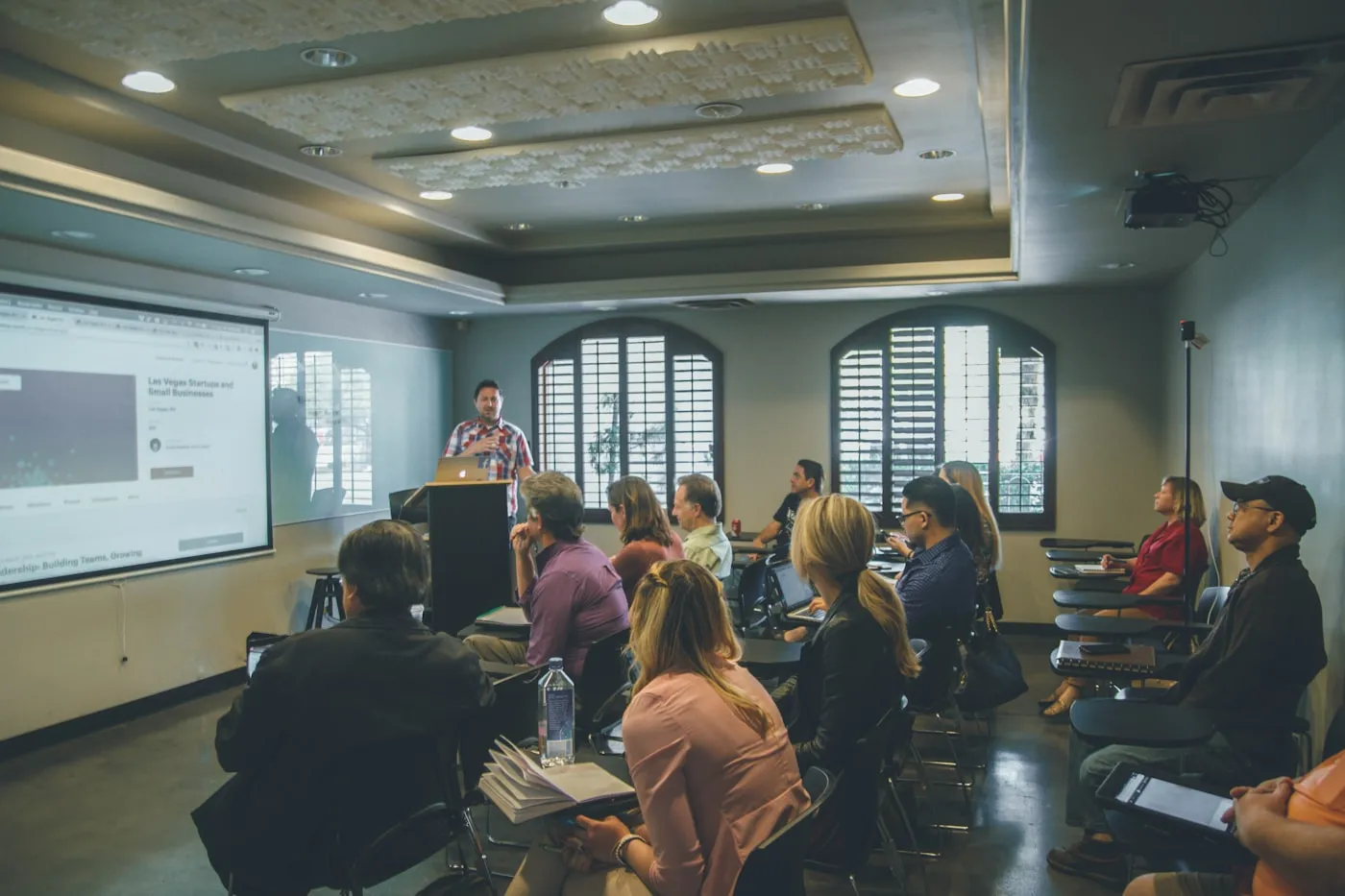
Can AI Replace a Language School? AI vs. Classroom for Learning German
AI tools like ChatGPT, Duolingo, and Babbel are powerful supplements — but they cannot replace a language school. Here’s why, and how to combine both for the fastest progress in German.
The question lands in my inbox every week: “Do I really need to pay for a language school? Can’t I just use ChatGPT?” It’s a fair question in 2026. AI has transformed how we access information, and language learning apps have never been more sophisticated. So let’s answer it honestly, with data — not marketing.
Short answer: AI is a remarkable tool. Language schools do something different. If you understand what each does well, you can use both together and progress faster than relying on either alone.
What AI Does Exceptionally Well
Let’s give credit where it’s due. AI language tools have solved real problems that traditional methods couldn’t.
1. Vocabulary and Grammar Drilling — Any Time, Any Pace
Open ChatGPT at 2 AM and ask it to quiz you on German separable verbs. It will — patiently, indefinitely, and for free. No human tutor works on call like that. Tools like Anki use spaced repetition algorithms to surface exactly the vocabulary you’re most likely to forget, maximizing retention per minute of study. This is genuinely better than flashcards, better than most textbook exercises, and available to anyone with a phone.
“Why is it dem Mann and not den Mann here?” Type that into ChatGPT and you get a grammatical explanation in seconds. Ask it to explain the Dativ case using examples from cooking, sports, or whatever context you find interesting. A good AI tutor is endlessly patient and never makes you feel embarrassed for asking the same question a fifth time.
3. Low-Stakes Conversation Practice
One of the biggest barriers in language learning is fear of embarrassment. You won’t make a fool of yourself in front of a chatbot. You can write a paragraph in German, get it corrected, write another, and gradually build confidence without social anxiety. For anxious learners, this is genuinely valuable.
4. Cost — Or Lack Thereof
ChatGPT’s free tier is powerful. Duolingo is free. Babbel costs around €8–12/month. Anki is free. You can build a serious study routine with zero budget. For someone on a tight income, or someone testing whether language learning fits their life before committing to a course, this matters enormously.
5. Personalized Pace
No waiting for the class to catch up. No skipping ahead because others need more time. Your pace is your pace. If you want to spend three weeks on Akkusativ before moving on, you can. If you grasp something immediately and want to advance, nothing stops you.
What AI Cannot Do — And Why This Matters
Here’s where honesty is required. The limitations of AI language learning are not minor. For anyone with serious goals — visa, certification, professional competence, or real-life German use — they are decisive.
1. Real Conversation With Real Consequences
Speaking German with a chatbot is practicing in a vacuum. You don’t feel the pause when you forgot a word mid-sentence. You don’t experience a native speaker’s confused expression when your grammar derails their understanding. You don’t learn to hold your nerve, recover, repair communication breakdowns. These are not peripheral skills — they are the core of language use.
Conversation in a classroom, with a teacher who stops you at the right moment and with classmates who laugh when something goes wrong and cheer when it goes right, is irreplaceable. The social stakes, even the small ones, drive acquisition in ways that a chatbot conversation simply cannot.
2. Error Pattern Diagnosis
A language teacher does not just correct mistakes. A good teacher notices that you make the same category of error consistently — that you always treat reflexive verbs as if they were transitive, or that you confuse weil and obwohl under any kind of time pressure. This kind of pattern recognition across dozens of interactions, and the targeted intervention it enables, does not happen reliably with AI. ChatGPT corrects the sentence in front of it. A teacher sees across the whole course of your development.
3. Certificates and Visa Eligibility
This is non-negotiable. If you need a German language certificate — Goethe-Institut, telc, TestDaF, or DSH — you need to take official exams prepared in official ways. No AI tool will issue you a certificate that immigration authorities, universities, or employers will accept. If your reason for learning German is linked to a visa application, a work permit, university admission, or professional licensing (medicine, nursing, law), AI tools are completely irrelevant to your legal requirements.
Language schools offer Goethe- and telc-accredited exam preparation. That path cannot be replaced.
4. Accountability and Structure
Be honest with yourself: how many apps did you download and stop using after two weeks? The streak features and gamification of Duolingo work for some people — but streaks don’t show up for class, and apps don’t notice when you’ve gone quiet for three weeks. A language school has a start date, a schedule, a teacher who calls your name, and classmates who notice when you’re absent. That structure produces consistent study in a way that “I’ll do it when I feel like it” rarely does.
5. Cultural and Emotional Depth
Language is culture. When a teacher explains that Germans say Ich freue mich auf den Winter with a particular warmth that a southerner might not understand, or that a Berliner “Jetzt mal Butter bei die Fische” is a signal that small talk is over — that’s not vocabulary. That’s cultural membership. Body language, irony, regional identity, humor — these are transmitted through human interaction, not algorithm.
6. Group Dynamics and Motivation
The other students in your class are not a distraction. They are a feature. You hear different accents, different mistakes, different strengths. You correct each other. You commiserate. You compete, gently. You share tips. Many learners discover that their most effective motivation is not wanting to be the worst in class — a social dynamic that no app replicates.
ChatGPT / Claude / Gemini
Best for: Conversation practice, grammar Q&A, writing correction, translation help, custom exercises.
Honest limitation: No speaking practice, no official content alignment, inconsistent grammar explanations for highly idiomatic language, no certificates.
Verdict: Excellent companion tool. Not a course.
Duolingo
Best for: Absolute beginners, vocabulary exposure, habit formation, daily engagement.
Honest limitation: Gamification replaces depth. Heavy English-language framing. Repetitive at higher levels. No path to B2+.
Verdict: Good for A1–A2 habits. Don’t confuse streaks with progress.
Babbel
Best for: Structured course-like progression, good grammar explanations, more serious than Duolingo.
Honest limitation: Still not a replacement for speaking practice or structured exam prep. Relatively expensive for what it is.
Verdict: Better than Duolingo for adult learners. Still a supplement.
DeepL
Best for: Translation reference, understanding authentic texts, checking your own German writing.
Honest limitation: Using it as a crutch prevents acquisition. It translates for you — it doesn’t teach you.
Verdict: Useful research tool. Don’t translate everything. Read the German first.
Anki
Best for: Vocabulary retention. Genuinely excellent spaced-repetition system.
Honest limitation: Requires discipline to set up and maintain. Not suitable for grammar or skills.
Verdict: Use it. Seriously. The best vocabulary tool available.
The Comparison Table
| Dimension | AI Tools | Language School |
|---|
| Cost | €0–15/month | €400–1,200/month |
| Flexibility | Total — any time, any place | Fixed schedule |
| Speaking practice | Low — no real stakes | High — daily interaction |
| Official certificates | None | Goethe, telc, TestDaF, DSH |
| Visa compliance | No | Yes (with accredited schools) |
| Cultural immersion | Minimal | High |
| Grammar accuracy | Good for standard cases | Excellent, personalized |
| Accountability | Low (app-dependent) | High (class structure) |
| Progress speed (beginner) | Moderate | Fast |
| Cultural competence | Low | High |
The Hybrid Strategy: How to Combine Both
Here is the approach that produces the best results in our experience, backed by consistent feedback from learners who have used both:
Use AI for:
- Vocabulary drilling between classes (Anki)
- Reviewing grammar explanations after lessons (ChatGPT)
- Writing practice — draft emails, messages, short texts in German, then get AI feedback
- Conversation rehearsal before a difficult real-world interaction (a job interview, a doctor’s appointment)
- Reading authentic German content and working through vocabulary you don’t know
- Keeping active on weekends when class isn’t running
Use your language school for:
- Structured progression through levels (A1 → B2 and beyond)
- Speaking practice with real stakes and real feedback
- Exam preparation for Goethe, telc, or TestDaF
- Visa and residence permit documentation
- Cultural orientation and social integration
- The accountability of scheduled classes
- Error pattern correction that only a teacher can provide
The combination looks like this: 4 hours of class per week, 1–2 hours of AI-assisted self-study per day. Vocabulary in Anki before sleep. ChatGPT for any grammar question that comes up. Your school for everything that matters for real life.
When AI Is Enough
There are genuine cases where AI tools can meet your needs without a language school:
- Hobby learning — You’re curious about German, have no deadline, and just want to explore at your own pace.
- Pre-arrival preparation — You’ve enrolled in a school and want to arrive at A1+ instead of zero. Use Duolingo, Babbel, or a few weeks of ChatGPT conversations to get a head start.
- Post-course maintenance — You completed a B2 course. You’re working, not studying. AI tools keep your German alive.
- Specific skill support — You read well but want more vocabulary. Anki. You understand but want writing practice. ChatGPT.
When You Absolutely Need a Language School
The following situations require a language school, period:
- Visa applications: Family reunification (Ehegattennachzug), Blue Card, or any visa requiring proven language ability — you need a certificate from an accredited institution.
- University admission: Most German universities require TestDaF or DSH results. These are formal exams requiring formal preparation.
- Professional licensing: Nurses, doctors, lawyers, engineers working in Germany often need regulated language certificates. Check your field’s requirements early.
- Integration course obligation: If you’re required to complete an integration course under German immigration law (Integrationskurs), this must be at a BAMF-certified school.
- Exam preparation: Taking a Goethe-Zertifikat, telc, or ÖSD exam? Schools know the format, the examiners, the point allocation. Self-study pass rates are significantly lower.
- You need structure: If you’ve tried apps three times and always quit after a month, the self-directed model doesn’t work for you. That’s not failure — it’s information. Book a course.
Cost Comparison: What’s the Real ROI?
AI only: €0–15/month. But without structure, you may spend 18 months reaching A2 (if you stay consistent — many don’t).
Language school only: €400–1,200/month depending on city and intensity. An intensive course takes you from A1 to B1 in roughly 3–4 months — faster than any app, with a certificate at the end.
Hybrid: Full-time intensive course (€800/month) + free AI supplement = €800/month. But your progress per month is faster, your exam pass rate is higher, and you retain more because you’re reinforcing class learning daily with AI practice.
The math favors the hybrid for anyone with real goals and a time horizon. AI supplements don’t save money if they extend your learning timeline from 4 months to 18.
The Teacher Factor
Let’s talk about what a great teacher actually provides — because this is where the “AI is good enough” argument breaks down most clearly.
A great German teacher watches you across weeks. They notice that your written German is strong but your spoken German collapses under time pressure. They know that you understand complex grammar when it’s explained but forget it in real-time production. They adapt not to “learner of German” but to you specifically.
They catch the moment your confidence dips. They push you past your comfort zone at exactly the right speed. They bring cultural context that isn’t in any textbook — the difference between how Germans communicate in Hamburg versus Bavaria, why certain phrases feel formal in some contexts and friendly in others. They know when to drill and when to let things breathe.
No AI system replicates this in 2026. Large language models are trained on text — they don’t observe you over time, they don’t read body language, they don’t teach with emotional intelligence. They are astonishing at what they do. What they do is not teaching.
Will AI Replace Language Schools in the Future?
This is worth asking honestly, because the honest answer is: not soon, and probably not completely.
AI tools will continue to improve dramatically. Real-time voice conversation AI (already available in ChatGPT and Gemini) will become far more natural. Pronunciation feedback will get better. Adaptive curriculum systems will become more sophisticated.
But language learning is not just information processing. It is a social activity. Communication skills develop through communication — with humans who have stakes in the interaction, who bring their full social presence to the exchange, who are affected by what you say and how you say it. The classroom is not just an information delivery mechanism. It is a community of practice.
The schools that will thrive are those that understand this and double down on what they uniquely offer: human interaction, cultural experience, certified outcomes, and the irreplaceable experience of learning alongside other people.
AI will make good learners better and lazy learners feel productive. The difference will show up in the exam room and the first week of a new job in Germany.
Related Articles
Frequently Asked Questions
Can ChatGPT teach me German?
ChatGPT can help you practice German — grammar questions, writing correction, conversation rehearsal, vocabulary help. It cannot teach you German in the sense of a structured course that takes you from A1 to B2 with certified outcomes. Use it as a supplement, not a curriculum.
Is Duolingo enough to learn German?
Duolingo is excellent for establishing basic vocabulary and daily habits at A1–A2 level. It is not sufficient for B1 or above, and it does not produce exam-ready competence, visa-eligible certificates, or fluent spoken German. Many people use Duolingo as a first step before enrolling in a school.
Do I need a language school for a German visa?
For most visa types requiring language proof — family reunification, Blue Card, integration course requirements — you need a certificate from an accredited institution. AI tools cannot provide this. Check with the relevant German authority or consulate for your specific visa type.
What AI tools are best for German learning?
For vocabulary: Anki (spaced repetition). For grammar help and writing practice: ChatGPT or Claude. For structured app learning: Babbel over Duolingo at intermediate levels. For translation reference: DeepL. Use these alongside a course, not instead of one.
How much does a German language course cost compared to AI tools?
AI tools cost €0–15/month. Language courses in Germany typically run €400–1,200/month depending on intensity and location. The cost difference is real — but so is the difference in outcomes. A 3-month intensive course often achieves what 18 months of app learning doesn’t.
Can I prepare for the Goethe-Zertifikat with AI alone?
You can use AI tools to support your exam preparation — practice writing, drill vocabulary, work through grammar. But the Goethe-Zertifikat has a specific format, evaluation criteria, and speaking component that require guided preparation with an experienced teacher. Self-study pass rates are lower; school-based preparation is significantly more effective.
Will AI replace language schools in the next 5 years?
Unlikely in the full sense. AI will continue improving and will become a standard part of how language learning works. But the human elements — certified outcomes, cultural immersion, accountability, real conversation with real stakes — will keep language schools relevant. The schools that adapt and integrate AI as a tool (rather than competing with it) will flourish.
What’s the best way to combine AI and a language school?
Use your school for structured lessons, speaking practice, and exam preparation. Use AI daily for reinforcement: vocabulary drilling (Anki), grammar review (ChatGPT), writing practice. One hour of AI-assisted self-study per day between classes significantly accelerates progress.
The Bottom Line
AI tools are genuinely useful for language learning. They democratize access, they work at any hour, and they offer patient, personalized support that no human tutor can match at scale. Use them.
But language learning — especially learning German for real-world use in Germany — requires human interaction, structured progression, certified outcomes, and cultural depth that AI cannot provide. A chatbot won’t come to your visa appointment. A streak counter won’t prepare you for the TestDaF oral component. A translation app won’t teach you to navigate a German workplace.
The best learners in 2026 will use both. They’ll attend their intensive course in the morning and review vocabulary with Anki in the evening. They’ll ask ChatGPT to explain a grammar rule their teacher mentioned and then apply it in class the next day. They’ll use AI to rehearse a difficult conversation before having it in real life.
That combination — structured human learning supplemented by intelligent tools — is what “learning German” looks like at its most effective.
Find a language school that fits your goals →

 language-school